It's cold outside. Colder than it was before the sun completed its journey, down below the line of mountains in the distance. There is a bite in the air, and as I take off on my run I see my breath come out in puffs.
As I get farther away from the warm glow of my house I touch my running belt compulsively, feeling for everything - gels, glucometer, pricker, test strips. It's all there. My finger tips are aching already and I haven't even made it to the lake. I feel my pace quicken.
Running in my town is different than I imagine road running in other places is - there are no 24/7 convenience stores, no stores at all actually, and I'm far more likely to see woodland creatures than other humans while on my journey. I think this increases my trepidation - I can't dash into a 7/11 and buy an apple juice if I under-pack. And as I make my way around the water in the stillness of the night, I start to wonder if anyone would see me if I went down. It's getting increasingly darker the further I go, under the hood of the trees with the woods edging up to the opposite side of the street. What animals come out at night? I can't remember.
As I approach one mile I've already decided I'm only going for two today - I'll loop around and turn back instead of completing the circle around the lake. I'm feeling the muscles in my back cramp up and thoroughly spooked by how poorly I can see. I wave my reader over my Libre sensor and am happy with the result - 146 - at first. But as I start into the second mile I feel a niggling in the pit of my stomach. Is the dark inhibiting my ability to feel my low? What about the cold?
I dig out my glucometer supplies and prick my finger as I run, a delicate skill I've learned to master. The number flashes on my meter - 76. The darkness acts as my friend then, hiding the annoyance on my face and bearing witness to the soft curses I whisper as I tear a gel open with my mouth. I toss the used test strip and methodically squeeze the gel into my mouth with my hands and teeth. When its done I cram the wrapper into my belt. I pick up speed. I'll sprint the rest of the way, I think, and this lasts about half a mile, until I feel the gel turning over in my stomach and the muscles seizing in my back. I slow my pace down again.
I feel the dark closing in on me, and I feel the urge to test again. Not until at least five minutes have passed. I reprimand myself and I keep running, fighting off thoughts of being too cold to feel my sugar dropping or of a feral raccoon surprising me in the darkness.
Finally the five minutes pass. I do my dance of testing while running again and feel simultaneously proud that I waited the full five minutes, and annoyed that I went low during my run. The number flashes - 89. I let out a loud sigh.
The lights from the beach come into view and I fall into an easy stride, trying to lower my heart rate and slow my breathing. I hit two miles and slow to a walk. My house is around the corner. I think of how we have no street lights here and how my friends in Bergen County find this terrifying.
When I make it through the front door I declare to my mother that I don't like running at night. She's thrilled. My sugar stays steady throughout dinnertime, and I tuck my fears away. Until next time.
Showing posts with label running. Show all posts
Showing posts with label running. Show all posts
Friday, October 26, 2018

Sunday, July 8, 2018
Thoughts on a Fractured Foot
As I write this, I stare pitifully down at my left foot and right knee. Each is carefully draped with an ice pack. My left foot is wrapped in an Ace bandage, awaiting an evaluation by an orthopedist for the fracture in my fifth metatarsal bone (think - the pinky bone of your foot). The swelling in my right knee seems to have gone down, but I'm over-icing it as a precaution. We still don't know what exactly is causing the knee swelling - it flares up after running or excessive walking. But a fracture in the left foot means crutches and weight-bearing only on the right leg. Which means pressure on the bad knee. Which means excruciating pain and more inflammation. My Omnipod sits inconspicuously on my left thigh, an afterthought. I use my PDM to bolus for my Sunday night ice cream, then spend five minutes over-thinking how much Aleve I should take before bed.
I'm not good at being still. Resting and elevating has been a challenge for me. Sure, I got to watch Moana and take a nap on the couch, but I like to be moving. Laying in bed last night, I didn't sleep much, unable to stop focusing on the pain in my knee. The more I lay around and think, the more often I came back to the same thought - am I being a huge wuss? This is temporary.

I mean, I've lived with type one diabetes every day of my life for the past 25 & 1/2 years. It comes to me as naturally as breathing. The pricks, the pokes, the highs, the lows...but this - struggling to get around - this is new for me. And its gotten me thinking. We struggle with what we're unfamiliar with. Someone from the outside looking in would probably assume that taking care of my diabetes is incredibly stressful. They would see the broken foot and think it was small potatoes compared to my daily finger pricks. But not me. For me, diabetes continues to be a nonchalant part of my daily life, while this foot fracture has me tossing and turning, butt-scooting and crawling around my house.
At the same time, I think that what we go through prepares us for what is to come. Time has passed and I've been given a boot for my broken foot. I've grown to have a love-hate relationship with the boot - much like the relationship I have with my diabetes supplies. I talk to it, I give a pat after it helps me get around, I consider naming it. I feel living with a pump has predisposed me to have a certain level of amicability towards health-gear. I realize the necessity of it and try not to begrudge it for doing its job.
We as humans are creatures of habit. It seems that for most of us, hard and easy are subjective - what's new is hard. Type one, for me, is easy compared to broken foot. And yes, in case you were wondering, I did decorate the boot. We'll see about the name.
I'm not good at being still. Resting and elevating has been a challenge for me. Sure, I got to watch Moana and take a nap on the couch, but I like to be moving. Laying in bed last night, I didn't sleep much, unable to stop focusing on the pain in my knee. The more I lay around and think, the more often I came back to the same thought - am I being a huge wuss? This is temporary.

I mean, I've lived with type one diabetes every day of my life for the past 25 & 1/2 years. It comes to me as naturally as breathing. The pricks, the pokes, the highs, the lows...but this - struggling to get around - this is new for me. And its gotten me thinking. We struggle with what we're unfamiliar with. Someone from the outside looking in would probably assume that taking care of my diabetes is incredibly stressful. They would see the broken foot and think it was small potatoes compared to my daily finger pricks. But not me. For me, diabetes continues to be a nonchalant part of my daily life, while this foot fracture has me tossing and turning, butt-scooting and crawling around my house.
At the same time, I think that what we go through prepares us for what is to come. Time has passed and I've been given a boot for my broken foot. I've grown to have a love-hate relationship with the boot - much like the relationship I have with my diabetes supplies. I talk to it, I give a pat after it helps me get around, I consider naming it. I feel living with a pump has predisposed me to have a certain level of amicability towards health-gear. I realize the necessity of it and try not to begrudge it for doing its job.
We as humans are creatures of habit. It seems that for most of us, hard and easy are subjective - what's new is hard. Type one, for me, is easy compared to broken foot. And yes, in case you were wondering, I did decorate the boot. We'll see about the name.
Thursday, June 28, 2018
Disconnected - switching to Omnipod
I'm reluctant to write another post with a positive review, since the day after I raved about my Libre I put in a new one and had a day of completely whacked out readings. The universe has a funny way of doing stuff like that. So I won't say that my switch over to the Omnipod has gone well.

I first started on a pump when I was 9 years old, and have been on one ever since. That's 17 years on a Medtronic. Needless to say, this was a big change for me. The adjustment has been interesting. I still find myself reaching for my waistband when I want to bolus. I catch myself guarding my waist when I walk through doorways or change my clothes. But after the initial disorientation, I've found myself feeling pretty liberated. Right now I have the pod on the back of my arm, and I feel like I can dance around and there's nothing attached to me.
For those of you who are unfamiliar with the system, there's two major parts to it. The pod, which is the insulin pump itself. The pod carries the insulin inside of it and sticks to your skin like a pump site would. It's changed every other/every two days. Then there's the PDM, which controls the pod through a wireless connection. The PDM doesn't have to be near the pod for you to get your basal. It just needs to be within communicating distance when you bolus. This is nice because when I go for a short run, I can set up my temp basal and leave my PDM at home. Or at work, I can leave it in my lunch bag and don't need to carry it around the hospital with me.


I first started on a pump when I was 9 years old, and have been on one ever since. That's 17 years on a Medtronic. Needless to say, this was a big change for me. The adjustment has been interesting. I still find myself reaching for my waistband when I want to bolus. I catch myself guarding my waist when I walk through doorways or change my clothes. But after the initial disorientation, I've found myself feeling pretty liberated. Right now I have the pod on the back of my arm, and I feel like I can dance around and there's nothing attached to me.
For those of you who are unfamiliar with the system, there's two major parts to it. The pod, which is the insulin pump itself. The pod carries the insulin inside of it and sticks to your skin like a pump site would. It's changed every other/every two days. Then there's the PDM, which controls the pod through a wireless connection. The PDM doesn't have to be near the pod for you to get your basal. It just needs to be within communicating distance when you bolus. This is nice because when I go for a short run, I can set up my temp basal and leave my PDM at home. Or at work, I can leave it in my lunch bag and don't need to carry it around the hospital with me.
The Switch
My first step in switching to the pod was to call the company (Insulet). I explained that I wanted to try out the pod, and they sent me an empty sample pod. I wore this for a couple of days and decided to give the real one a shot. If you're currently using a competing company for pump therapy (i.e. Medtronic, TSlim), Insulet will send you a month's supply of pods with a PDM. If you don't like it, you can keep the PDM at no cost and keep using your old system. This was reassuring for me because it felt like such a big change to dive into without a safety net.
Insulet has you complete a form so that they can verify coverage with your insurance company. This is another important thing to consider before making a switch. Luckily the pods were covered at the same percentage my Medtronic supplies were, and will end up being about the same cost out of pocket every three months.
What I Like
Less Supplies: Since the pods have their reservoir inside of them, its only them you have to worry about. This makes for easier packing, storing and traveling with supplies.
Insertion: I'm not sure if it's mental or what, but just sticking the pod on and pressing a button without ever having to see the needle or hear that loud click makes it seem like an easier and less painful insertion.
Freedom: As I mentioned before, the ability to dance around without worrying about something falling off your hip is just pretty exciting after 19 years on a tubed pump. Plus, the pods have gotten much smaller since they first came out. They may be more noticeable than a pump site, especially in the summertime, but for me it's worth the extra asks and looks.
Dash System
Something else exciting on the horizon is the recent FDA approval of the Dash system for the pod. This will include a slimmer PDM that will be able to communicate with the Contour Next test kit, made by Bayer. This was the system I was using with my Medtronic pump, which is nice because soon it will be compatible with my pod system. The Dash will also use Bluetooth technology for its connection with the pod, which seems to be a precursor to more advanced technology (smartphone apps, the works).
If you've been thinking about switching over to the pod, I've say give it a shot. Worst case scenario, you don't like it and go back to your old system without having to shell out any money. If you're on MDI, request a sample pod and see how you feel about wearing it for a couple of days.

Sunday, June 3, 2018
My Libre Experience
By now I'm sure many of you have heard about or seen pictures of the Freestyle Libre system. For those of you who haven't, here's how it works:
The system has two parts: the sensor and the reader. The sensor is itty bitty and gets inserted into the back of your arm. It stays in for up to ten days. When you want to get data, you click on the reader and simply wave it over the sensor. It gives you your current BG, along with a graph of your previous readings for as long as you've been wearing it. The reader also tells you if you're trending rapidly up or down, slowly up or down, or running steady.
Unlike the Dex or Medtronic system, the sensor doesn't automatically give you your numbers - you have to wave it to get the data. This means there's no alert system if you're about to go low or if you're creeping up. The reader works through clothing, and it has a built in Freestyle meter as well.

Journey to Libre
I started my journey, of course, with insurance issues. When I first attempted to pick up the system at the pharmacy, they told me that insurance covered none of it. This was when it first came out in the US, in the beginning of 2018. It was also VERY difficult to locate a participating pharmacy that had it in stock. After a frustrating failed attempt, I spent a couple of months on the Enlite system, as it was covered by my new insurance. I did get some good data with this, but I went through too many inaccurate readings and failed insertions. My mind drifted back to the Libre. I decided to go through the company, and let them battle it out. They reached out to my endo to get a prescription, and went back and forth between her office, the pharmacy, and insurance. The system ended up being partially covered, and the out of pocket is less than the Enlite system for me.
Bringing the Libre home was super exciting - at this point I'd heard more and more about how convenient and accurate it was, and was itching to try it out. I was especially excited to use it while running. I've been on it now for about a month, and am thrilled so far. The readings are accurate, I'm pricking my finger less, and I feel like a spy from the future every time I wave the reader and get hours of data. Not to mention I have the system decked out in gear from Pimp My Diabetes and T1D Chick. There are certain aspects of the system that I can see some people being hesitant towards, depending on their situation. Below I've detailed my pros and cons.
PROS
Accuracy: My libre is almost always spot on. I trust it, which is a big deal for me. Small discrepancies tend to happen when I'm rising or dropping quickly, like with most CGMs.

Duration: Sensor change is every 10 days. Enough said.
Dual meter: The reader can also be used as a meter with Freestyle Precision Neo strips. These strips are super convenient too- they're wrapped individually in foil so you can fold them up flat. I use them for when I'm running, at work, or need to carry less bulk. Then I don't have to carry my usual meter as well.
Cost: Even with the lower rate of insurance coverage, the out of pocket still ends up lower than the Enlite for me. The original market price of the system is lower than other sensors.
Minimizes alert anxiety: If you feel your lows and highs and aren't reliant on the alerts on the Dex/Medtronic, this can be a good option for you. I tend to have alert anxiety, in which I get alerted that I'm dropping or rising and tend to over-correct. The Libre eliminates this for me.
Minimizes alert anxiety: If you feel your lows and highs and aren't reliant on the alerts on the Dex/Medtronic, this can be a good option for you. I tend to have alert anxiety, in which I get alerted that I'm dropping or rising and tend to over-correct. The Libre eliminates this for me.
CONS
No alerts: If you don't feel your lows and highs, this system may not be ideal for you. While it's easy to scan and check your BG, you don't have the peace of mind that may come with the alert system.
Not technically "continuous": Because you have to scan the reader over the sensor, the system isn't technically considered a CGM. It isn't automatic - you have to put the little bit of effort into it.
Insurance: Because the system is so new, it's less likely to be covered by insurance. Or if it is, it may not be completely covered. I anticipate that as time goes by and more people use it, more insurance companies will offer more coverage.
Bottom Line
Bottom line is, if your insurance will cover it, I highly recommend trying it out. It's small, accurate and fun to use. My coworkers in the medical field are in awe of it. Plus, it's always fun to hear people guess what the heck is on your arm. So far I've gotten:
- A penny (this guess was from a 3-year-old)
- A radiation sensor
- Miscellaneous crap stuck to my arm ("Hey, you've got something stuck there")
We'll see what guess comes next...
Sunday, February 18, 2018
Running While Diabetic
I've always loved to run. When I was a little girl, I was quick. Like, faster-than-the-boys quick. As I got older I lost my speed. I dabbled in sprints freshman and sophomore year during track, but it didn't stick. As the years passed I struggled to find a niche in exercise, something that I really loved and could bring myself to do on a regular basis. I was surprised to find myself back to my roots - in running.
When I was a teenager I never thought I could run distance. I didn't feel I had the energy or the stamina. But as I went through college and got more familiar with the treadmill and the track, something shifted. I found I could run small distances if I paced myself. I loved the feeling of settling into just the right pace, where I could breathe somewhat normally and didn't feel like I was going to have a heart attack. It gave me a great feeling of satisfaction afterwards.
Lately I've gotten back into running. My brother and I ran a couple of 5k's, and I found myself falling back in love with the feeling of accomplishment and exhaustion a good run gave. Planned 5k's and runs in particular are exciting for me. When I have that concrete goal ahead of me, I find it easier to get myself motivated.
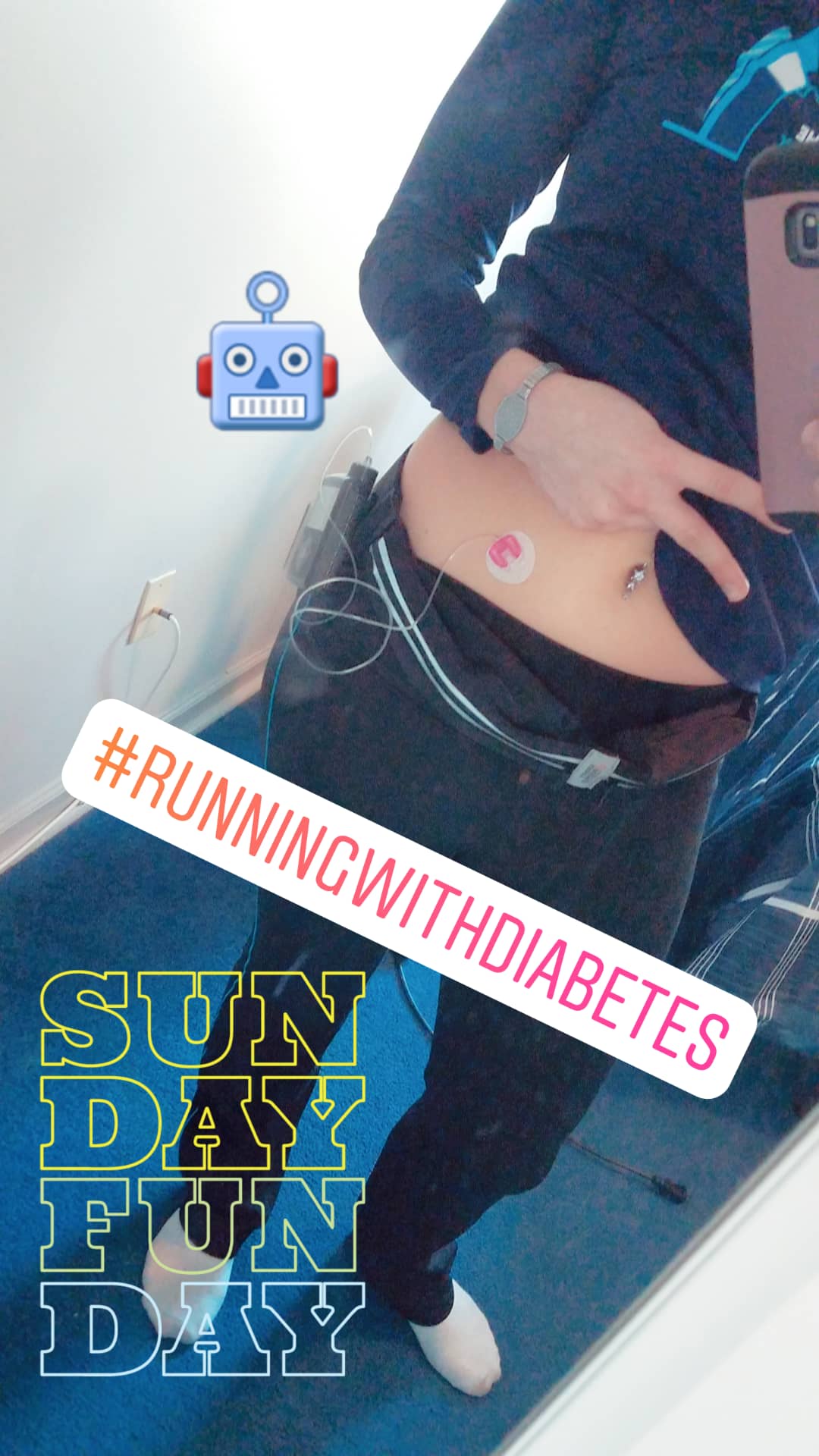
My main challenge with running is, of course, keeping my blood sugar stable. It's an extra level of sorcery to master in addition to the complexity of just having diabetes. I experience drops during my runs, after my runs, in the middle of the night of my runs, you name it. Then there are the spikes. The adrenaline a good run gives works as a double-edged sword, and can lead to BG spikes during or after runs. I am still in the process of finding a routine that works for me. Typically I take my pump off during the run itself. Gatorade is usually helpful when it's thrown in the mix, whether I drink it during or before or after, or all three.
Lately I've been following along with Type One Run's "Couch to 5k" program on Facebook. Although I've done 5k's before, I wanted to get back in running shape after my last one in November and get going towards preparing for my goal this year - a 10k. The program has step-by-step instructions for every day and can be done without a gym membership, which I love. What I love most, though, is the sense of community and the abundance of resources the group brings. Having a group of type ones easily accessible means being able to ask for advice and share your own helpful tips. So even though I haven't found my perfect routine for a stable BG (and let's be real - probably never will), I have a pool of tips and tricks I can dip into until I find what works best.
When I was a teenager I never thought I could run distance. I didn't feel I had the energy or the stamina. But as I went through college and got more familiar with the treadmill and the track, something shifted. I found I could run small distances if I paced myself. I loved the feeling of settling into just the right pace, where I could breathe somewhat normally and didn't feel like I was going to have a heart attack. It gave me a great feeling of satisfaction afterwards.
Lately I've gotten back into running. My brother and I ran a couple of 5k's, and I found myself falling back in love with the feeling of accomplishment and exhaustion a good run gave. Planned 5k's and runs in particular are exciting for me. When I have that concrete goal ahead of me, I find it easier to get myself motivated.
My main challenge with running is, of course, keeping my blood sugar stable. It's an extra level of sorcery to master in addition to the complexity of just having diabetes. I experience drops during my runs, after my runs, in the middle of the night of my runs, you name it. Then there are the spikes. The adrenaline a good run gives works as a double-edged sword, and can lead to BG spikes during or after runs. I am still in the process of finding a routine that works for me. Typically I take my pump off during the run itself. Gatorade is usually helpful when it's thrown in the mix, whether I drink it during or before or after, or all three.
Lately I've been following along with Type One Run's "Couch to 5k" program on Facebook. Although I've done 5k's before, I wanted to get back in running shape after my last one in November and get going towards preparing for my goal this year - a 10k. The program has step-by-step instructions for every day and can be done without a gym membership, which I love. What I love most, though, is the sense of community and the abundance of resources the group brings. Having a group of type ones easily accessible means being able to ask for advice and share your own helpful tips. So even though I haven't found my perfect routine for a stable BG (and let's be real - probably never will), I have a pool of tips and tricks I can dip into until I find what works best.
Subscribe to:
Posts (Atom)