Healthcare has been a hot button issue lately here in the states. Of course for those of us who live with a chronic illness, it has always been an issue. But with the 2016 election, healthcare along with many other public policies have come to the forefront of the nationwide conversation. And frankly, the conversations have been quite alarming.
There is an overwhelming population of people who believe that healthcare has to be earned. That the right to live is not an inherent right for all humans (even though our US Constitution specifically states otherwise). People feel that if you work hard, pay your dues, and play by the rules, you will A: Stay healthy, and B: Be granted great insurance coverage, God forbid anything should happen to you. This logic is flawed. Chronic and/or acute health issues can happen to anyone, at anytime, for a variety of reasons. As a species, humans don't like to believe this. It creates what's called "cognitive dissonance," which is when we are presented with a reality that doesn't match up with what we've always believed. It therefore causes dissonance, or disruption, so we do everything in our power to ignore the reality and continue on with our faulty beliefs. We cannot reconcile reality with our wishes because it causes discomfort.
Most people grow up hoping or believing that they will have good health. This is normal - it's a positive outlook on life. However, as we grow older we tend to experience certain realities - maybe we're diagnosed with type 1 diabetes, someone we love is in an accident, our parent gets laid off and we almost lose our insurance - and we are able to shift our beliefs accordingly to read more like this: things may not always be easy. Things could happen to us and our family. But for some people, this adjustment doesn't happen. They continue to believe that bad things come to those who deserve it and that healthcare should be earned.
So is the issue that people are inherently bad and have complete disregard for others? I hope not. No, what I think is happening in the majority of cases is that people are simply rigid in their beliefs due to concerns about their own self-preservation. And this needs to change. We need to challenge our beliefs because they are flawed. Yes, it is a frightening reality to accept - that we could be struck with an illness or hit by a car at any time. But we are doing more harm than good by holding on to the flawed belief that we are in total and complete control of our health or our circumstances. It is not reality.
The reality is, every human has an inherent right to live. And for some humans, what they need to live - and live well - is a bit more extensive than what others need. So I challenge you all - what belief do you cling to that begrudges others their inherent rights? How can you start to chip away at that belief and re-frame it?
Showing posts with label diabetic lifestyle. Show all posts
Showing posts with label diabetic lifestyle. Show all posts
Friday, March 1, 2019

Thursday, December 20, 2018
The Power of Words
"Words are, in my not-so-humble opinion, our most inexhaustible source of magic." - Albus Dumbledore.
 |
| Sticker from Pimp My Diabetes |
So many nuances exist in communication. If someone casually asks "you're diabetic?" versus a brash "you're a diabetic?", I'm likely to have different reaction. There's so many nonverbal cues - body language, tone, facial expression. No one wants to feel that someone is accusing them of something, and most people don't like to be the recipient of sad puppy eyes. The words themselves aren't the whole picture. But they're a big part of it.
Compliance vs. Adherence
I've talked before about the word compliance in the medical field and the negative connotation it can have. The word "comply" is so similar to "obey." People living with chronic illness are already stuck with a disease they didn't ask for. Admonishing them for not "obeying" to this illness will convey that you're on the illness' side, not theirs. Because of how long and how heavily the word has been used, it's gained a derogatory nature . Hearing "non-compliant" being used to describe someone feels like hearing a dirty word. It stains a person's medical record, strikes trepidation into most providers, and causes bias when assessing a person, whether you realize it or not. There have been recommendations to switch to the word "adherent," which to me makes more sense and is kinder. Asking if someone is adhering to their regimen acknowledges the patient's role in their illness, while creating a comfortable space for them to have a conversation about what their barriers are to self-care.
Control vs. Manage
Recently I was listening to Rob Howe's podcast, Diabetics Doing Things, and came across his interview with Erin Aker, founder of the Diabulimia Helpline. In her interview she talked about the word "control," and how detrimental it can be for mental health. While control is important for diabetes management, intense desire for control can manifest into different forms of anxiety. Especially when it comes to managing a chronic illness that is so difficult to control.
While I've had my own struggles with control and fear of losing it, I've never given much consideration to the power the word itself holds and how we can shake that power. Aker talked about using the word "management" versus "control." I felt like a light bulb went off in my head. Such a simple shift - swapping out one word for another - could make such a difference. If we keep thinking about our diabetes in terms of control, we're more prone to become obsessive. Re-training our brain to use the word "manage" eases some of the pressure. It is a more benign word, from a mental health perspective. I encourage everyone in the chronic illness community to consider what Aker talked about.
What language do you prefer when it comes to your diabetes? Do you have a preference? Many people say words don't matter to them as much as the content of the conversation. Comment below and let me know your thoughts.
Friday, November 23, 2018
Trust & Type 1

The glucometer.
This is the OG diabetes tech. It's what I've been using since infancy. When I was a baby, my parents used to prick my toes to test me (I was diagnosed at 13 months old). Because of this, my glucometer often feels like my lifeline. It's been there literally my entire life, giving me the data I need to treat myself. Granted, there are days that my numbers are so wacky that I stare at my meter in frustration and wonder, are you lying to me?
The meter has evolved over the years - becoming slimmer, quicker, and requiring less blood from my callused fingers. But the idea is still essentially the same. Prick the finger, get the number, react accordingly. I would say that I rely heavily on my glucometer - because I trust it.
The pump.
Coming along in my grade school years, the pump took some time to earn my trust. When it first came out, I remember writing in my diary in wonderment, marveling at the fact that I didn't have to use MDI (multiple daily injections) anymore. I remember putting my "very last syringe" in my memory box the night before my pump training. It was a huge deal for me.
Maybe because of this, I was crushed when I had a rough go of it the first time around. I struggled with highs; had one particularly traumatizing, painful, kinked catheter; and site changes for some reason terrified me. I eventually went off the pump for a year or two until my parents & I felt I was ready to try it again. I've remained a pumper since then.
But still, there are days where I feel that doubt niggling at the back of my mind. What if my pump malfunctions? What if I can't get my insulin? What if I get too much? Can I really trust this device functioning as my pancreas? Clearly, this doubt isn't significant enough to cause me to switch back to MDI, but still, it is there.
Maybe because of this, I was crushed when I had a rough go of it the first time around. I struggled with highs; had one particularly traumatizing, painful, kinked catheter; and site changes for some reason terrified me. I eventually went off the pump for a year or two until my parents & I felt I was ready to try it again. I've remained a pumper since then.
But still, there are days where I feel that doubt niggling at the back of my mind. What if my pump malfunctions? What if I can't get my insulin? What if I get too much? Can I really trust this device functioning as my pancreas? Clearly, this doubt isn't significant enough to cause me to switch back to MDI, but still, it is there.
The CGM.
Thus far in my diabetic life I've had two CGM experiences - Medtronic Enlite and Freestyle Libre, the system that I currently use. I was weary of this tech at the beginning, and was adamant that I didn't want something else attached to me. I was also a high schooler, and annoyingly stubborn. As I got older, I began to grow curious. But alas, it wasn't meant to be - my insurance did not think that this (statistically proven life-improving) technology was "medically necessary." So, I went without until I enrolled in my own insurance this year.
If you follow me on Instagram or read my blog, you know that I'm in love with my little Libre. But it's a new love. It's still deepening. The trust still needs to grow. I get asked all the time, "So you don't have to prick your finger anymore?" And I wince, because I know I really don't have to as often as I do. But kicking an almost-26-year habit is hard.
To be fair to myself, there are discrepancies between the readings, and for the Libre it is recommended to check via finger stick before making treatment decisions. Still, there is room for improvement on my end. I feel the doubt trying to drown me, telling me "just make sure" or "just prick your finger, it's no big deal." I am hoping that with time, I'll develop a functional doubt:trust ratio.
Bottom line.
As human beings, we're comfortable with what we know. We are, in fact, creatures of habit. It's been my experience that people who were diagnosed at a younger age, or many years ago, are more familiar with the older tech and are more weary of relying so heavily on the new stuff. But those diagnosed during this stage of the game, where CGMs are the norm, feel much more comfortable trusting in their gadgets. A big part of this is about feeling safe. I feel safest testing my sugar the old-fashioned way, because it's what I knew for so long.
My hope is that with time and practice, my trust will continue to deepen. My other hope is for you to know that if this is something you struggle with as well - you're not alone!
Sunday, November 18, 2018
Planes, Trains & Snow Delays - Costa Rica 2018
Pura Vida.
"Pure life." It's the phrase of Costa Rica, where I spent the last 6 days. I can say with certainty that the country measures up to this saying. It was beautiful: lush with wildlife, green forest, and full of amazing views and experiences. Every day, especially those where we ventured outside the resort, felt full of life.
Me and my best friend, who I've known since babyhood, traveled together and this is the farthest south we've gone so far. The flight from Newark was about 5 hours. We stayed in the northwestern part of the county, in the province of Guanacaste. This was my first trip with my Omnipod as well. Overall, my diabetes wasn't troublesome during vacation.

What I packed.
To say I over-pack for vacation is an understatement. But hey, better safe than sorry, right? For this trip I knew I would have to change my pod twice, so I packed six pods - four more than needed, just in case any didn't work or fell off in the jungle. I packed extra batteries for my PDM. An extra pump - my old Medtronic - with two infusion sets and reservoirs to go with it if needed. A full vial of insulin, an extra glucometer, charger for my glucometer, some extra lancets, and two full bottles of test strips. Oh, and low supplies.
For my lows I packed a big baggie of gels, and two juices. I've learned recently that you can bring your juice through TSA at the airport in your carry-on. If you inform them why you're carrying it, they will swab it and let you bring it through. We didn't check any baggage, so this was super-helpful. I also have a small army of pills I take daily, so I filled up my 7-day pill case and packed all the bottles as well - that way I can show what the pills are and that they are prescribed to me, if needed.
Lately I've been using Vial Safe to keep my insulin safe during travel. I kept my PDM, libre, and glucometer with a gel in my Clark double zip bag from Myabetic. This was my go-to bag for vacation - brought it to the beach, carried it in my backpack at the airport, and used it as a little clutch at night. I also brought the new Jay sling bag from Myabetic which I found VERY helpful during our excursions. It fit lots of stuff and is more sporty and water-resistant than the other bags, which was good because it poured during our rainforest walk. When we went zip-lining, I was able to clip it around my waist like a fanny pack. All of my extra supplies go into my zippy "All My Diabetes Shit" bag by Casualty Girl.
For my lows I packed a big baggie of gels, and two juices. I've learned recently that you can bring your juice through TSA at the airport in your carry-on. If you inform them why you're carrying it, they will swab it and let you bring it through. We didn't check any baggage, so this was super-helpful. I also have a small army of pills I take daily, so I filled up my 7-day pill case and packed all the bottles as well - that way I can show what the pills are and that they are prescribed to me, if needed.
Lately I've been using Vial Safe to keep my insulin safe during travel. I kept my PDM, libre, and glucometer with a gel in my Clark double zip bag from Myabetic. This was my go-to bag for vacation - brought it to the beach, carried it in my backpack at the airport, and used it as a little clutch at night. I also brought the new Jay sling bag from Myabetic which I found VERY helpful during our excursions. It fit lots of stuff and is more sporty and water-resistant than the other bags, which was good because it poured during our rainforest walk. When we went zip-lining, I was able to clip it around my waist like a fanny pack. All of my extra supplies go into my zippy "All My Diabetes Shit" bag by Casualty Girl.
Keeping the shoogs in check.
Something I've learned about myself is that I run high on vacation. Whether it's the adrenaline, the high fat food my body isn't used to, the drinking, or a combo of the three, I'm not sure. What I did this time is created a "Travel" basal program with doses .2 units higher than my regular basal. It worked well with a little tinkering. After dinner I still would need a jacked up temp basal for a couple of hours. It's amazing how sensitive our bodies are to change. At home I really don't drink with dinner and we eat very healthy. Even having 1-2 drinks on vacation and eating food that was richer but that I didn't necessarily think was "high fat," my sugars would skyrocket without that extra basal.
Something else I strongly recommend is water. It's so important to stay hydrated when you're laying out in the sun, especially if you're drinking. I grabbed a water with every drink I had, and every hour or so out by the pool even if I wasn't drinking. It just makes my body feel better.

 Our second trip was much longer. We took a bus to Lake Arenal, which was about a 3 hour ride. However, we had a great tour guide who taught us all about the history of the country and showed us all the sights. We had lunch in a local town where I met a little cat and fed her some of my tilapia. After lunch, we took a boat across the lake and had an amazing view of the volcano. Afterwards we stopped at another eco-park and took a walking tour through the rainforest, followed by some time at a hot springs lodge, then wrapped up the day with dinner at a beautiful hotel up in the mountains over the lake. There are tons of eco-hotels in the mountains near Lake Arenal that I would love to stay at one day. The views are amazing and you really are surrounded by the beauty of the country.

Excursions.
As lovely as it is to lay by the water, have some cocktails and just do nothing, mixing in excursions is a must for me on vacation. I love to see the country I'm in, learn about its history and its people, and experience everything I can in the time I have.
Our first trip was to Diamante Eco Park, which has an animal sanctuary and an aerial zip-lining course. We got to see monkeys, jaguars, sloths, and toucans! I never realized how beautiful toucans are and now have developed just a tiny obsession with them.
After the animal sanctuary it was off to zip-lining over the mountains. I've zip-lined before, but this was something else. The second zip was Superman style - face first. It was high over the ocean, and we could see our resort in its entirety from above. Definitely not for the faint of heart, but an amazing experience for those who love these kinda things.
 Our second trip was much longer. We took a bus to Lake Arenal, which was about a 3 hour ride. However, we had a great tour guide who taught us all about the history of the country and showed us all the sights. We had lunch in a local town where I met a little cat and fed her some of my tilapia. After lunch, we took a boat across the lake and had an amazing view of the volcano. Afterwards we stopped at another eco-park and took a walking tour through the rainforest, followed by some time at a hot springs lodge, then wrapped up the day with dinner at a beautiful hotel up in the mountains over the lake. There are tons of eco-hotels in the mountains near Lake Arenal that I would love to stay at one day. The views are amazing and you really are surrounded by the beauty of the country.
Airport Shenanigans.
I'm a fairly light packer, so I try not to check baggage unless absolutely necessary. For this trip, I brought a mini-suitcase as a carry-on, and a big backpack for a personal item. Some airlines also allow you to carry a medical bag at no additional charge - make sure you look into this! It can be super helpful, especially if you have to check some bags.
Coming home to New Jersey, we were expecting some snow. Some snow. We were not at all expecting the hot mess that was to come.
In retrospect, we should have had some sense of foreboding when the hotel phone rang at 2:40 AM. Our shuttle ride was scheduled for 3:20 AM, but there must have been a miscommunication - the driver arrived at 2:30. We scrambled our things together and hustled down to the lobby, still half-asleep.
Things went relatively smoothly after that until we got to Houston. We had a layover there, and once we landed and had lunch we saw that our flight was pushed back an hour. Okay, not so bad. However, just as we were about to get on the plane, we were stopped. There wasn't anymore room for carry-ons. We would have to check a bag. Quickly, I crammed all my medical stuff into my backpack and forked over my little suitcase. We boarded, got comfy and waited.
And waited.
And...got delayed another hour.
Once we finally took off, everyone's nerves were a little frayed. This didn't improve when, two hours into the flight, the pilot made an announcement that Newark was totally iced out. We would be landing in Cleveland and waiting the storm out. It turned out that we would have to wait until the next morning to fly back home.
Small calamities like this are why it's so important to be over-prepared medication-wise. Also, to have everything essential on your person. We had no access to our checked bags overnight. I may not have had a toothbrush, but at least I had my insulin.
After an airport dinner with our fellow stranded souls, we made our way to a hotel airport, punch-drunk from exhaustion and missing our pets. At the end of the day though, we were happy to be safe and sound from the ravages of the storm.

In retrospect, we should have had some sense of foreboding when the hotel phone rang at 2:40 AM. Our shuttle ride was scheduled for 3:20 AM, but there must have been a miscommunication - the driver arrived at 2:30. We scrambled our things together and hustled down to the lobby, still half-asleep.
Things went relatively smoothly after that until we got to Houston. We had a layover there, and once we landed and had lunch we saw that our flight was pushed back an hour. Okay, not so bad. However, just as we were about to get on the plane, we were stopped. There wasn't anymore room for carry-ons. We would have to check a bag. Quickly, I crammed all my medical stuff into my backpack and forked over my little suitcase. We boarded, got comfy and waited.
And waited.
And...got delayed another hour.
Once we finally took off, everyone's nerves were a little frayed. This didn't improve when, two hours into the flight, the pilot made an announcement that Newark was totally iced out. We would be landing in Cleveland and waiting the storm out. It turned out that we would have to wait until the next morning to fly back home.
Small calamities like this are why it's so important to be over-prepared medication-wise. Also, to have everything essential on your person. We had no access to our checked bags overnight. I may not have had a toothbrush, but at least I had my insulin.
After an airport dinner with our fellow stranded souls, we made our way to a hotel airport, punch-drunk from exhaustion and missing our pets. At the end of the day though, we were happy to be safe and sound from the ravages of the storm.

Bottom Line.
Bottom line from this trip: Be prepared. Over-pack. Visit Costa Rica if you love the outdoors and love outdoor activities. And again: Over. Pack.

Thursday, September 27, 2018
Data Overload
Technology's advances in today's world have become a hot-button issue. Is it as helpful as it is hurtful? Is the constant connection to the blue screen just too much? Rudimentary statistics have come out regarding the pros and cons of tech, but it may be too soon to tell what the long-standing impacts are on our overall well-being. When it comes to diabetes tech, the concerns are no less significant.

Continuous glucose monitors
Probably the biggest advance in diabetes technology since the insulin pump, Continuous Glucose Monitors (CGMs) have become widely used tools by both type 1s and type 2s. Whether you're a Guardian, Libre, or Dexcom user, you no doubt know how much this technology has impacted your diabetes care. These little guys check our blood sugars without us having to finger stick, tell us if we are trending up or down, and even tell us the speed at which we're trending. They alert us, our phones, and even our loved ones if we so choose. It sounds amazing to most people, but there's a downside here.
What's helpful about a CGM can also be harmful - we are inundated with data. This constant stimulation can be super overwhelming, especially for someone who's had diabetes since long before this tech was available. Before CGMs, you would test, bolus, eat and then not think about your BGs so much until you were going to eat again or if you were symptomatic. We didn't know what was going on in between our finger sticks. Now, we know immediately when our sugars begin to rise or drop. The issue is, once we see those dreaded arrows, it's difficult for some of us to just observe. We feel the need to correct, even though our sugars are supposed to rise after meals. That's just what happens. Just like sugars start to drop when we exercise. There is a constant pressure to have the straightest line possible, but is this really realistic? Trending down doesn't mean we are bound for a hypo, and trending up doesn't mean our IOB won't bring us down like it's supposed to.Too much of a good thing?

A common vibe
If you don't believe me that this awesome technology has a downside, I'm not the only one feeling it. I recently read a post from Libby Russel for Beyond Type 1, reflecting on her experience using a Dexcom. This spot-on hits all the frustration that comes with wearing a sensor. Reading about Libby's struggles and her relating her Dexcom to an overly attentive boyfriend was super relatable (and hysterical). Data overload is also touched on a lot in Out of Range, Beta Cell's podcast with Craig & Laura. And an overwhelming seventy percent of Instagram followers who participated in my poll agreed they over-correct based on sensor data. These little arrows can wreak havoc on our peace of mind.
Now, don't get me wrong. CGM is an amazing tool to better know your patterns, and is essential for people who don't feel their lows. But it can be a tough road, learning how to calmly observe our numbers without overreacting and panicking. It's a skill that takes practice and fine-tuning. But we're used to that, huh?
Now, don't get me wrong. CGM is an amazing tool to better know your patterns, and is essential for people who don't feel their lows. But it can be a tough road, learning how to calmly observe our numbers without overreacting and panicking. It's a skill that takes practice and fine-tuning. But we're used to that, huh?
Friday, August 24, 2018
Type 1 and Guilt
There is a specter floating around in the type 1 community. It haunts people and parents living with type 1, coming out to play during our lowest moments. The specter is guilt. Feeling like a burden.
There's definitely a difference in the kinds of guilt experienced by those who have type 1 and those whose loved ones have type 1 (namely, parents). Parents of type 1s may experience guilt in several ways: guilt that their child is sick, guilt that they couldn't prevent it, that they couldn't protect them, that they could have caught it sooner, and so on. Upon diagnosis parents often need to be reassured that there was nothing they could have done to cause their child's diabetes, or anything they could have done to prevent it. Very often, it is parents' keen eye and instinct that bring their child in to the doctor or the emergency room. They took care of their children, as most parents do, to the best of their knowledge and ability.
For those who have type 1 themselves, the relationship with guilt can be more insidious. Even for those who are diagnosed young (myself included), guilt will worm its way into thoughts and feelings about diabetes. I have a vivid memory of having to be picked up early from ballet class after a low at around age 10. After 15 minutes of sitting and wallowing in my sorrow, my mother arrived to get me. "Sorry I'm such a burden on you and Dad," I spat as a hello. I remember her being appalled - her and my father never complained about having to take care of me. Why would I say such a thing? Was I being a drama queen? Not exactly.

There's definitely a difference in the kinds of guilt experienced by those who have type 1 and those whose loved ones have type 1 (namely, parents). Parents of type 1s may experience guilt in several ways: guilt that their child is sick, guilt that they couldn't prevent it, that they couldn't protect them, that they could have caught it sooner, and so on. Upon diagnosis parents often need to be reassured that there was nothing they could have done to cause their child's diabetes, or anything they could have done to prevent it. Very often, it is parents' keen eye and instinct that bring their child in to the doctor or the emergency room. They took care of their children, as most parents do, to the best of their knowledge and ability.
 |
| Parents of type 1 answered a 50/50 split of feeling guilt regarding their child's diagnosis. (Instagram: @diabetictruths) |
For those who have type 1 themselves, the relationship with guilt can be more insidious. Even for those who are diagnosed young (myself included), guilt will worm its way into thoughts and feelings about diabetes. I have a vivid memory of having to be picked up early from ballet class after a low at around age 10. After 15 minutes of sitting and wallowing in my sorrow, my mother arrived to get me. "Sorry I'm such a burden on you and Dad," I spat as a hello. I remember her being appalled - her and my father never complained about having to take care of me. Why would I say such a thing? Was I being a drama queen? Not exactly.
Feeling like a burden

When it comes to feeling like a burden, it seems that I was far from alone in my feelings. What I've found - on social media, at work, or listening to different type 1 podcasts - is that the majority of type 1s struggle with this feeling from time to time.
However, this issue isn't just specific to diabetes. The Kidney Disease Quality of Life Survey (KDQOL), administered to dialysis patients ages 18 and older, specifically asks the same question I posed to other type 1s on my Instagram. The KDQOL asks in its "True or False" section how true the statement "I feel like a burden on my family" is. Feelings of guilt and shame aren't just things that diabetics struggle with - it seems that any chronic illness that significantly impacts daily life poses a risk of this side effect.

 On the upside, it seems that people living with type 1 don't feel this way all of the time. More commonly, they feel this way on bad diabetes days. Like all negative thoughts, guilt tends to creep up on us during difficult moments. If our sugar levels are really out of whack and we have to rely heavily on our loved ones, we're more prone to feel like a burden or a bother.
Also, if diabetes interferes with plans or social activities, it seems the majority of type 1s are reluctant to break the news to those they are spending time with. It would make sense that this is reluctance stems from that same fear - feeling like a burden. Ruining the day for everyone. Interrupting the fun with your diabetes. These thoughts can be seriously detrimental to our state of mind - thoughts like these increase shame, guilt and embarrassment, which can lower our sense of self-worth.
However, this issue isn't just specific to diabetes. The Kidney Disease Quality of Life Survey (KDQOL), administered to dialysis patients ages 18 and older, specifically asks the same question I posed to other type 1s on my Instagram. The KDQOL asks in its "True or False" section how true the statement "I feel like a burden on my family" is. Feelings of guilt and shame aren't just things that diabetics struggle with - it seems that any chronic illness that significantly impacts daily life poses a risk of this side effect.

 On the upside, it seems that people living with type 1 don't feel this way all of the time. More commonly, they feel this way on bad diabetes days. Like all negative thoughts, guilt tends to creep up on us during difficult moments. If our sugar levels are really out of whack and we have to rely heavily on our loved ones, we're more prone to feel like a burden or a bother.
 Also, if diabetes interferes with plans or social activities, it seems the majority of type 1s are reluctant to break the news to those they are spending time with. It would make sense that this is reluctance stems from that same fear - feeling like a burden. Ruining the day for everyone. Interrupting the fun with your diabetes. These thoughts can be seriously detrimental to our state of mind - thoughts like these increase shame, guilt and embarrassment, which can lower our sense of self-worth.
Why?
Guilt and shame are feelings. Feelings are a direct result of our thoughts - how we perceive what is going on around us. So what thoughts are we having that feed these feelings of guilt?
I have to cut this hike short. My sugar's going low.
This is awful. I'm ruining everyone's day.
My mom gets so worried about me. I am such a burden to this family.
The issue with these thoughts is that without realizing it, we are over-identifying with our diabetes. Yes, our moms are worried about us. But is it you yourself that is the stressor on the family? Or is it your diabetes? It's often hard for us to remember - they are two different entities. Parents may have been devastated about our diagnosis, but it is our diabetes they are upset with, not us. We might be upset that we have to cut the hike short, but it's diabetes that interrupted the day, not us.
This isn't to say that we should shirk all responsibilities that come along with diabetes. Even though diabetes is a separate entity, it is still something we have some control over. Rather, this is about changing our thoughts regarding diabetes and ourselves. It's about changing the way you talk to yourself (otherwise referred to as self-talk) about your type 1. Diabetes may be an integral part of who you are, but it is not you yourself.
Saturday, July 28, 2018
Resource Hub
NOW IN PROGRESS
Who doesn't love resources?
As a social worker, much of what I do is provide resources. Whether it's for finances, prescriptions, mental health, or community support, there is an abundance of resources to be found and shared. The more time I spend in my field, the more I realize how the type 1 community would benefit from many of these resources. This is why I'll be constructing a resource hub that will become a permanent page of my blog. You can find it next to the "Medical Disclaimer" bar. This will be an ongoing project - I'll continue to add resources as I come across them. Most importantly, I want to hear from you guys - know of a resource that I don't have on my page? Have a good or a bad experience with one of them? Let me know!! The resource hub will go live on Thursday, August 2nd, so stay tuned.

Sunday, July 8, 2018
Thoughts on a Fractured Foot
As I write this, I stare pitifully down at my left foot and right knee. Each is carefully draped with an ice pack. My left foot is wrapped in an Ace bandage, awaiting an evaluation by an orthopedist for the fracture in my fifth metatarsal bone (think - the pinky bone of your foot). The swelling in my right knee seems to have gone down, but I'm over-icing it as a precaution. We still don't know what exactly is causing the knee swelling - it flares up after running or excessive walking. But a fracture in the left foot means crutches and weight-bearing only on the right leg. Which means pressure on the bad knee. Which means excruciating pain and more inflammation. My Omnipod sits inconspicuously on my left thigh, an afterthought. I use my PDM to bolus for my Sunday night ice cream, then spend five minutes over-thinking how much Aleve I should take before bed.
I'm not good at being still. Resting and elevating has been a challenge for me. Sure, I got to watch Moana and take a nap on the couch, but I like to be moving. Laying in bed last night, I didn't sleep much, unable to stop focusing on the pain in my knee. The more I lay around and think, the more often I came back to the same thought - am I being a huge wuss? This is temporary.

I mean, I've lived with type one diabetes every day of my life for the past 25 & 1/2 years. It comes to me as naturally as breathing. The pricks, the pokes, the highs, the lows...but this - struggling to get around - this is new for me. And its gotten me thinking. We struggle with what we're unfamiliar with. Someone from the outside looking in would probably assume that taking care of my diabetes is incredibly stressful. They would see the broken foot and think it was small potatoes compared to my daily finger pricks. But not me. For me, diabetes continues to be a nonchalant part of my daily life, while this foot fracture has me tossing and turning, butt-scooting and crawling around my house.
At the same time, I think that what we go through prepares us for what is to come. Time has passed and I've been given a boot for my broken foot. I've grown to have a love-hate relationship with the boot - much like the relationship I have with my diabetes supplies. I talk to it, I give a pat after it helps me get around, I consider naming it. I feel living with a pump has predisposed me to have a certain level of amicability towards health-gear. I realize the necessity of it and try not to begrudge it for doing its job.
We as humans are creatures of habit. It seems that for most of us, hard and easy are subjective - what's new is hard. Type one, for me, is easy compared to broken foot. And yes, in case you were wondering, I did decorate the boot. We'll see about the name.
I'm not good at being still. Resting and elevating has been a challenge for me. Sure, I got to watch Moana and take a nap on the couch, but I like to be moving. Laying in bed last night, I didn't sleep much, unable to stop focusing on the pain in my knee. The more I lay around and think, the more often I came back to the same thought - am I being a huge wuss? This is temporary.

I mean, I've lived with type one diabetes every day of my life for the past 25 & 1/2 years. It comes to me as naturally as breathing. The pricks, the pokes, the highs, the lows...but this - struggling to get around - this is new for me. And its gotten me thinking. We struggle with what we're unfamiliar with. Someone from the outside looking in would probably assume that taking care of my diabetes is incredibly stressful. They would see the broken foot and think it was small potatoes compared to my daily finger pricks. But not me. For me, diabetes continues to be a nonchalant part of my daily life, while this foot fracture has me tossing and turning, butt-scooting and crawling around my house.
At the same time, I think that what we go through prepares us for what is to come. Time has passed and I've been given a boot for my broken foot. I've grown to have a love-hate relationship with the boot - much like the relationship I have with my diabetes supplies. I talk to it, I give a pat after it helps me get around, I consider naming it. I feel living with a pump has predisposed me to have a certain level of amicability towards health-gear. I realize the necessity of it and try not to begrudge it for doing its job.
We as humans are creatures of habit. It seems that for most of us, hard and easy are subjective - what's new is hard. Type one, for me, is easy compared to broken foot. And yes, in case you were wondering, I did decorate the boot. We'll see about the name.
Thursday, June 28, 2018
Disconnected - switching to Omnipod
I'm reluctant to write another post with a positive review, since the day after I raved about my Libre I put in a new one and had a day of completely whacked out readings. The universe has a funny way of doing stuff like that. So I won't say that my switch over to the Omnipod has gone well.

I first started on a pump when I was 9 years old, and have been on one ever since. That's 17 years on a Medtronic. Needless to say, this was a big change for me. The adjustment has been interesting. I still find myself reaching for my waistband when I want to bolus. I catch myself guarding my waist when I walk through doorways or change my clothes. But after the initial disorientation, I've found myself feeling pretty liberated. Right now I have the pod on the back of my arm, and I feel like I can dance around and there's nothing attached to me.
For those of you who are unfamiliar with the system, there's two major parts to it. The pod, which is the insulin pump itself. The pod carries the insulin inside of it and sticks to your skin like a pump site would. It's changed every other/every two days. Then there's the PDM, which controls the pod through a wireless connection. The PDM doesn't have to be near the pod for you to get your basal. It just needs to be within communicating distance when you bolus. This is nice because when I go for a short run, I can set up my temp basal and leave my PDM at home. Or at work, I can leave it in my lunch bag and don't need to carry it around the hospital with me.


I first started on a pump when I was 9 years old, and have been on one ever since. That's 17 years on a Medtronic. Needless to say, this was a big change for me. The adjustment has been interesting. I still find myself reaching for my waistband when I want to bolus. I catch myself guarding my waist when I walk through doorways or change my clothes. But after the initial disorientation, I've found myself feeling pretty liberated. Right now I have the pod on the back of my arm, and I feel like I can dance around and there's nothing attached to me.
For those of you who are unfamiliar with the system, there's two major parts to it. The pod, which is the insulin pump itself. The pod carries the insulin inside of it and sticks to your skin like a pump site would. It's changed every other/every two days. Then there's the PDM, which controls the pod through a wireless connection. The PDM doesn't have to be near the pod for you to get your basal. It just needs to be within communicating distance when you bolus. This is nice because when I go for a short run, I can set up my temp basal and leave my PDM at home. Or at work, I can leave it in my lunch bag and don't need to carry it around the hospital with me.
The Switch
My first step in switching to the pod was to call the company (Insulet). I explained that I wanted to try out the pod, and they sent me an empty sample pod. I wore this for a couple of days and decided to give the real one a shot. If you're currently using a competing company for pump therapy (i.e. Medtronic, TSlim), Insulet will send you a month's supply of pods with a PDM. If you don't like it, you can keep the PDM at no cost and keep using your old system. This was reassuring for me because it felt like such a big change to dive into without a safety net.
Insulet has you complete a form so that they can verify coverage with your insurance company. This is another important thing to consider before making a switch. Luckily the pods were covered at the same percentage my Medtronic supplies were, and will end up being about the same cost out of pocket every three months.
What I Like
Less Supplies: Since the pods have their reservoir inside of them, its only them you have to worry about. This makes for easier packing, storing and traveling with supplies.
Insertion: I'm not sure if it's mental or what, but just sticking the pod on and pressing a button without ever having to see the needle or hear that loud click makes it seem like an easier and less painful insertion.
Freedom: As I mentioned before, the ability to dance around without worrying about something falling off your hip is just pretty exciting after 19 years on a tubed pump. Plus, the pods have gotten much smaller since they first came out. They may be more noticeable than a pump site, especially in the summertime, but for me it's worth the extra asks and looks.
Dash System
Something else exciting on the horizon is the recent FDA approval of the Dash system for the pod. This will include a slimmer PDM that will be able to communicate with the Contour Next test kit, made by Bayer. This was the system I was using with my Medtronic pump, which is nice because soon it will be compatible with my pod system. The Dash will also use Bluetooth technology for its connection with the pod, which seems to be a precursor to more advanced technology (smartphone apps, the works).
If you've been thinking about switching over to the pod, I've say give it a shot. Worst case scenario, you don't like it and go back to your old system without having to shell out any money. If you're on MDI, request a sample pod and see how you feel about wearing it for a couple of days.

Sunday, June 3, 2018
My Libre Experience
By now I'm sure many of you have heard about or seen pictures of the Freestyle Libre system. For those of you who haven't, here's how it works:
The system has two parts: the sensor and the reader. The sensor is itty bitty and gets inserted into the back of your arm. It stays in for up to ten days. When you want to get data, you click on the reader and simply wave it over the sensor. It gives you your current BG, along with a graph of your previous readings for as long as you've been wearing it. The reader also tells you if you're trending rapidly up or down, slowly up or down, or running steady.
Unlike the Dex or Medtronic system, the sensor doesn't automatically give you your numbers - you have to wave it to get the data. This means there's no alert system if you're about to go low or if you're creeping up. The reader works through clothing, and it has a built in Freestyle meter as well.

Journey to Libre
I started my journey, of course, with insurance issues. When I first attempted to pick up the system at the pharmacy, they told me that insurance covered none of it. This was when it first came out in the US, in the beginning of 2018. It was also VERY difficult to locate a participating pharmacy that had it in stock. After a frustrating failed attempt, I spent a couple of months on the Enlite system, as it was covered by my new insurance. I did get some good data with this, but I went through too many inaccurate readings and failed insertions. My mind drifted back to the Libre. I decided to go through the company, and let them battle it out. They reached out to my endo to get a prescription, and went back and forth between her office, the pharmacy, and insurance. The system ended up being partially covered, and the out of pocket is less than the Enlite system for me.
Bringing the Libre home was super exciting - at this point I'd heard more and more about how convenient and accurate it was, and was itching to try it out. I was especially excited to use it while running. I've been on it now for about a month, and am thrilled so far. The readings are accurate, I'm pricking my finger less, and I feel like a spy from the future every time I wave the reader and get hours of data. Not to mention I have the system decked out in gear from Pimp My Diabetes and T1D Chick. There are certain aspects of the system that I can see some people being hesitant towards, depending on their situation. Below I've detailed my pros and cons.
PROS
Accuracy: My libre is almost always spot on. I trust it, which is a big deal for me. Small discrepancies tend to happen when I'm rising or dropping quickly, like with most CGMs.

Duration: Sensor change is every 10 days. Enough said.
Dual meter: The reader can also be used as a meter with Freestyle Precision Neo strips. These strips are super convenient too- they're wrapped individually in foil so you can fold them up flat. I use them for when I'm running, at work, or need to carry less bulk. Then I don't have to carry my usual meter as well.
Cost: Even with the lower rate of insurance coverage, the out of pocket still ends up lower than the Enlite for me. The original market price of the system is lower than other sensors.
Minimizes alert anxiety: If you feel your lows and highs and aren't reliant on the alerts on the Dex/Medtronic, this can be a good option for you. I tend to have alert anxiety, in which I get alerted that I'm dropping or rising and tend to over-correct. The Libre eliminates this for me.
Minimizes alert anxiety: If you feel your lows and highs and aren't reliant on the alerts on the Dex/Medtronic, this can be a good option for you. I tend to have alert anxiety, in which I get alerted that I'm dropping or rising and tend to over-correct. The Libre eliminates this for me.
CONS
No alerts: If you don't feel your lows and highs, this system may not be ideal for you. While it's easy to scan and check your BG, you don't have the peace of mind that may come with the alert system.
Not technically "continuous": Because you have to scan the reader over the sensor, the system isn't technically considered a CGM. It isn't automatic - you have to put the little bit of effort into it.
Insurance: Because the system is so new, it's less likely to be covered by insurance. Or if it is, it may not be completely covered. I anticipate that as time goes by and more people use it, more insurance companies will offer more coverage.
Bottom Line
Bottom line is, if your insurance will cover it, I highly recommend trying it out. It's small, accurate and fun to use. My coworkers in the medical field are in awe of it. Plus, it's always fun to hear people guess what the heck is on your arm. So far I've gotten:
- A penny (this guess was from a 3-year-old)
- A radiation sensor
- Miscellaneous crap stuck to my arm ("Hey, you've got something stuck there")
We'll see what guess comes next...
Sunday, May 27, 2018
The Stamp of Compliance
If you're a type one, you've likely accumulated a litany of diagnoses over your lifetime. Hashimotos, celiac, lupus, the works. They pile on, accruing in your chart over the years. Maybe this bothers you, maybe it doesn't. There's constant debate about the power of labels and how one's diagnostic label can help or hurt them if they over-identify with it. But the more time I spend in the medical field, the more I notice a label that doesn't seem to yield any benefit: compliant. Or, for our purposes, non-compliant.
Over time, doctors need to monitor your diagnoses and how you are managing your health. But seeing non-compliant or history of non-compliance tacked onto a patient chart tends to create an image in a provider's mind before they even meet their patient. There is a level of judgement that inevitably occurs once your diagnostic labels include compliance issues. Much like words that we no longer use due to the negative connotation and derogatory nature they became so closely linked with, compliance is beginning to get a bit of a bad rep. Why? To start, let's look at the definition:
Obeying. Yielding. Not exactly words I would appreciate being used towards me as a patient. "You must obey your diabetes regimen." I'm trying to live my best life, not surrender at battle in Winterfell. I've heard certain healthcare providers talk about a shift toward using the word adherence, which I personally think is better. The bottom line is, the word compliance has developed a stigma. To have such a strong label as a diagnostic tool on a patient's chart is a risky move. It becomes easy to say, "This patient is non-compliant. I better not get my hopes up. They're probably not doing what they're supposed to."
This label extends beyond diabetes - it applies to all chronic illnesses, whether it's ESRD, epilepsy, or asthma. It can be so easy to say, "Well, this patient's non-compliant. They don't want to care for themselves," when this may not be the case. There is another approach. When assessing patients and families I prefer to ask, "Are you able to take your medications/follow your diet/etc. as prescribed?" Asking from a place of non-judgement and not-knowing allows space for the patient to ask for help if they need it. Maybe they aren't taking their medication because their insurance doesn't cover it. Maybe they're struggling with an underlying anxiety or depression, or could just benefit from some educational counseling. Simply labeling someone as non-compliant and leaving it at that eliminates any possibility for improvement. And people living with chronic illness deserve a chance for improvement. Being stuck in a place where they are struggling to care for themselves doesn't have to be a place where they remain.
So what now? Other than adherence, what words would you prefer to have used, as a patient or as a provider? I am curious to know.
Over time, doctors need to monitor your diagnoses and how you are managing your health. But seeing non-compliant or history of non-compliance tacked onto a patient chart tends to create an image in a provider's mind before they even meet their patient. There is a level of judgement that inevitably occurs once your diagnostic labels include compliance issues. Much like words that we no longer use due to the negative connotation and derogatory nature they became so closely linked with, compliance is beginning to get a bit of a bad rep. Why? To start, let's look at the definition:
 |
| source: www.dictionary.com |
Obeying. Yielding. Not exactly words I would appreciate being used towards me as a patient. "You must obey your diabetes regimen." I'm trying to live my best life, not surrender at battle in Winterfell. I've heard certain healthcare providers talk about a shift toward using the word adherence, which I personally think is better. The bottom line is, the word compliance has developed a stigma. To have such a strong label as a diagnostic tool on a patient's chart is a risky move. It becomes easy to say, "This patient is non-compliant. I better not get my hopes up. They're probably not doing what they're supposed to."
This label extends beyond diabetes - it applies to all chronic illnesses, whether it's ESRD, epilepsy, or asthma. It can be so easy to say, "Well, this patient's non-compliant. They don't want to care for themselves," when this may not be the case. There is another approach. When assessing patients and families I prefer to ask, "Are you able to take your medications/follow your diet/etc. as prescribed?" Asking from a place of non-judgement and not-knowing allows space for the patient to ask for help if they need it. Maybe they aren't taking their medication because their insurance doesn't cover it. Maybe they're struggling with an underlying anxiety or depression, or could just benefit from some educational counseling. Simply labeling someone as non-compliant and leaving it at that eliminates any possibility for improvement. And people living with chronic illness deserve a chance for improvement. Being stuck in a place where they are struggling to care for themselves doesn't have to be a place where they remain.
So what now? Other than adherence, what words would you prefer to have used, as a patient or as a provider? I am curious to know.
Sunday, May 20, 2018
Sleep: A Fickle Friend
My relationship with sleep has always been odd. I love sleep. But when I was a child, I had night terrors. I always needed a night light, and I still can't sleep in total darkness. I'm also a violent sleeper. My friends who've shared rooms with me say I run in my sleep, kick in my sleep, throw things in my sleep...
 I wake up and the room is a mess. My stuffed animals are everywhere. My blankets are askew. Bottom line is, my sleep has never been particularly restful.
As I adjust to adulting and having a full-time job, one of the things I've prioritized is trying to get as restful a night's sleep as possible. But the more time I spend trying to get a good night's sleep, the more I am reminded of an unpleasant truth: type 1 is not at all conducive to rest. And I am not alone in this. Other T1D's feel the same, as do their family members I'm sure. How does any parent of a T1D child get a full night's rest? My mom still doesn't sleep, and I'm 26 (sorry mom).
There's many parts of diabetes that interfere with sleep. To start, the equipment. Anyone with a pump knows what it's like to wake at 3am entangled in tubing (Podders excluded). There are times when I drift seamlessly between sleep and wake, just long enough to grab my pump, roll to the side, and place it so it's not wrapped around my waist. This may not be a lot of time awake, but it adds up.
Then there's the tech. CGMs can simultaneously help and interfere with sleep, depending on the person. On the one hand, the CGM is a great tool for waking those who don't feel their lows or highs. This is essential for getting a good night's sleep - because who can rest when they're worried about dropping low and not feeling it? Those who don't feel their lows and parents of young children can more than likely rest easily knowing their CGM is there for them. On the other hand, some CGMs are less accurate than others. False alarms ringing out in the night are incredibly frustrating. There's also the risk of over-checking and over-treating - seeing a downward/upward arrow when you roll over and glimpse at your graph, and giving an unneeded correction or laying awake with worry. Much like having a cell phone in the bed, the CGM is stimulation. It is a double-edged sword.
What else?
High BG - up all night to pee.
Low BG - up all night to eat. Followed by a rebound and a wave of nausea.
Bum pump site - have you ever had to change your site in the twilight hours while still half-asleep? Not fun.
Along with all of this comes the general anxiety of just being diabetic - and trying to sleep. Whether it's worrying about lows or highs, worrying about whether a correction will work and how you'll be when you wake up, or trying to remember if you've re-stocked your bedroom juice, diabetes is not a disease that plays nice with restful sleep. Because of this, I try to get into my bed early enough that I have more than enough time to get in eight hours - since I know 100% of the time in bed will likely not be spent sleeping.
 I wake up and the room is a mess. My stuffed animals are everywhere. My blankets are askew. Bottom line is, my sleep has never been particularly restful.
As I adjust to adulting and having a full-time job, one of the things I've prioritized is trying to get as restful a night's sleep as possible. But the more time I spend trying to get a good night's sleep, the more I am reminded of an unpleasant truth: type 1 is not at all conducive to rest. And I am not alone in this. Other T1D's feel the same, as do their family members I'm sure. How does any parent of a T1D child get a full night's rest? My mom still doesn't sleep, and I'm 26 (sorry mom).
There's many parts of diabetes that interfere with sleep. To start, the equipment. Anyone with a pump knows what it's like to wake at 3am entangled in tubing (Podders excluded). There are times when I drift seamlessly between sleep and wake, just long enough to grab my pump, roll to the side, and place it so it's not wrapped around my waist. This may not be a lot of time awake, but it adds up.
Then there's the tech. CGMs can simultaneously help and interfere with sleep, depending on the person. On the one hand, the CGM is a great tool for waking those who don't feel their lows or highs. This is essential for getting a good night's sleep - because who can rest when they're worried about dropping low and not feeling it? Those who don't feel their lows and parents of young children can more than likely rest easily knowing their CGM is there for them. On the other hand, some CGMs are less accurate than others. False alarms ringing out in the night are incredibly frustrating. There's also the risk of over-checking and over-treating - seeing a downward/upward arrow when you roll over and glimpse at your graph, and giving an unneeded correction or laying awake with worry. Much like having a cell phone in the bed, the CGM is stimulation. It is a double-edged sword.
What else?
High BG - up all night to pee.
Low BG - up all night to eat. Followed by a rebound and a wave of nausea.
Bum pump site - have you ever had to change your site in the twilight hours while still half-asleep? Not fun.
Along with all of this comes the general anxiety of just being diabetic - and trying to sleep. Whether it's worrying about lows or highs, worrying about whether a correction will work and how you'll be when you wake up, or trying to remember if you've re-stocked your bedroom juice, diabetes is not a disease that plays nice with restful sleep. Because of this, I try to get into my bed early enough that I have more than enough time to get in eight hours - since I know 100% of the time in bed will likely not be spent sleeping.
Sunday, February 18, 2018
Running While Diabetic
I've always loved to run. When I was a little girl, I was quick. Like, faster-than-the-boys quick. As I got older I lost my speed. I dabbled in sprints freshman and sophomore year during track, but it didn't stick. As the years passed I struggled to find a niche in exercise, something that I really loved and could bring myself to do on a regular basis. I was surprised to find myself back to my roots - in running.
When I was a teenager I never thought I could run distance. I didn't feel I had the energy or the stamina. But as I went through college and got more familiar with the treadmill and the track, something shifted. I found I could run small distances if I paced myself. I loved the feeling of settling into just the right pace, where I could breathe somewhat normally and didn't feel like I was going to have a heart attack. It gave me a great feeling of satisfaction afterwards.
Lately I've gotten back into running. My brother and I ran a couple of 5k's, and I found myself falling back in love with the feeling of accomplishment and exhaustion a good run gave. Planned 5k's and runs in particular are exciting for me. When I have that concrete goal ahead of me, I find it easier to get myself motivated.
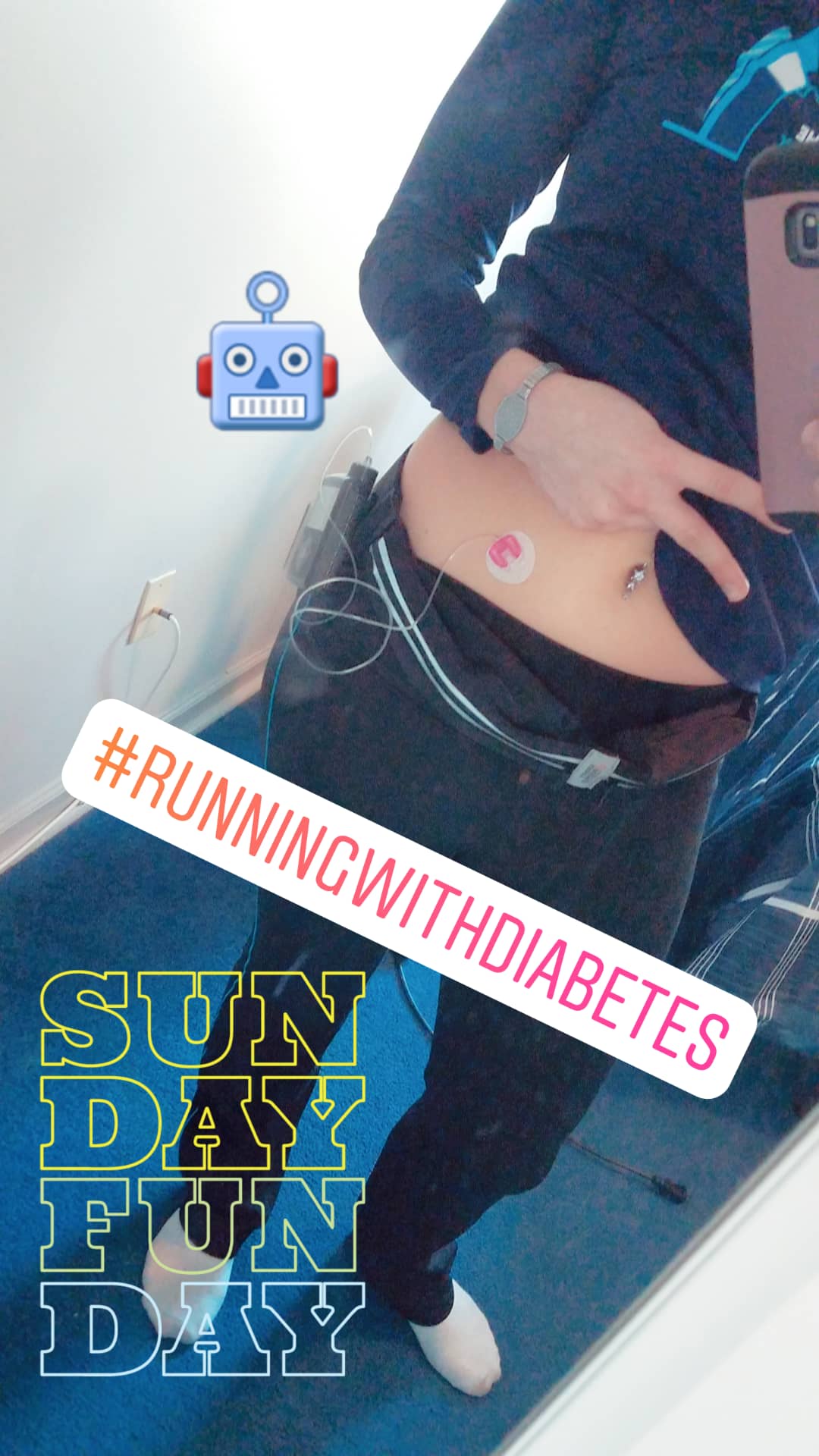
My main challenge with running is, of course, keeping my blood sugar stable. It's an extra level of sorcery to master in addition to the complexity of just having diabetes. I experience drops during my runs, after my runs, in the middle of the night of my runs, you name it. Then there are the spikes. The adrenaline a good run gives works as a double-edged sword, and can lead to BG spikes during or after runs. I am still in the process of finding a routine that works for me. Typically I take my pump off during the run itself. Gatorade is usually helpful when it's thrown in the mix, whether I drink it during or before or after, or all three.
Lately I've been following along with Type One Run's "Couch to 5k" program on Facebook. Although I've done 5k's before, I wanted to get back in running shape after my last one in November and get going towards preparing for my goal this year - a 10k. The program has step-by-step instructions for every day and can be done without a gym membership, which I love. What I love most, though, is the sense of community and the abundance of resources the group brings. Having a group of type ones easily accessible means being able to ask for advice and share your own helpful tips. So even though I haven't found my perfect routine for a stable BG (and let's be real - probably never will), I have a pool of tips and tricks I can dip into until I find what works best.
When I was a teenager I never thought I could run distance. I didn't feel I had the energy or the stamina. But as I went through college and got more familiar with the treadmill and the track, something shifted. I found I could run small distances if I paced myself. I loved the feeling of settling into just the right pace, where I could breathe somewhat normally and didn't feel like I was going to have a heart attack. It gave me a great feeling of satisfaction afterwards.
Lately I've gotten back into running. My brother and I ran a couple of 5k's, and I found myself falling back in love with the feeling of accomplishment and exhaustion a good run gave. Planned 5k's and runs in particular are exciting for me. When I have that concrete goal ahead of me, I find it easier to get myself motivated.
My main challenge with running is, of course, keeping my blood sugar stable. It's an extra level of sorcery to master in addition to the complexity of just having diabetes. I experience drops during my runs, after my runs, in the middle of the night of my runs, you name it. Then there are the spikes. The adrenaline a good run gives works as a double-edged sword, and can lead to BG spikes during or after runs. I am still in the process of finding a routine that works for me. Typically I take my pump off during the run itself. Gatorade is usually helpful when it's thrown in the mix, whether I drink it during or before or after, or all three.
Lately I've been following along with Type One Run's "Couch to 5k" program on Facebook. Although I've done 5k's before, I wanted to get back in running shape after my last one in November and get going towards preparing for my goal this year - a 10k. The program has step-by-step instructions for every day and can be done without a gym membership, which I love. What I love most, though, is the sense of community and the abundance of resources the group brings. Having a group of type ones easily accessible means being able to ask for advice and share your own helpful tips. So even though I haven't found my perfect routine for a stable BG (and let's be real - probably never will), I have a pool of tips and tricks I can dip into until I find what works best.
Sunday, February 11, 2018
Don't Ruin Your Daycation
Overnight Stays & Daycations with T1D
If you've traveled with type 1 before, you know how much pack and prep is involved. Extra supplies, more extra supplies, keeping your medical supplies in your carry-on, and the works. But things are easy to overlook when you're just going for a quick overnight getaway, or taking a daycation to a local spot. Because you're going so close, it can be easy to under-pack and forget the essentials.
This past week I took the train into NYC where I stayed overnight at my brother & sister-in-laws'. While it's relatively close (about an hour by train), I would find myself in a real pickle if my tubing got caught in a subway turnstile and ripped my site out. Getting back home via NJ Transit without planning ahead is a real hassle, and it would cut my trip short, which would bum everyone out. To try to avoid this, whenever I go to places that aren't easy to get home from, I make sure to pack extra everything - even if it's a short trip.
Of course, this means bigger baggage. But this is a necessary evil that I've found to always be a part of the type 1 lifestyle. This week, I stuffed my new canvas tote to the top and tried to keep it safely tucked under my arm during my trek. Something I find helpful is stuffing everything important towards the bottom of the bag, or wrapping them in clothes so they're less likely to fall out. Of course, I keep my meter and some juice easily accessible in my purse. Top priorities are:
Batteries. I always forget about batteries, until I've got 30 minutes left in my pump and have to scramble around wherever I'm at, thieving from remote controls.
This past week I took the train into NYC where I stayed overnight at my brother & sister-in-laws'. While it's relatively close (about an hour by train), I would find myself in a real pickle if my tubing got caught in a subway turnstile and ripped my site out. Getting back home via NJ Transit without planning ahead is a real hassle, and it would cut my trip short, which would bum everyone out. To try to avoid this, whenever I go to places that aren't easy to get home from, I make sure to pack extra everything - even if it's a short trip.
Of course, this means bigger baggage. But this is a necessary evil that I've found to always be a part of the type 1 lifestyle. This week, I stuffed my new canvas tote to the top and tried to keep it safely tucked under my arm during my trek. Something I find helpful is stuffing everything important towards the bottom of the bag, or wrapping them in clothes so they're less likely to fall out. Of course, I keep my meter and some juice easily accessible in my purse. Top priorities are:
Batteries. I always forget about batteries, until I've got 30 minutes left in my pump and have to scramble around wherever I'm at, thieving from remote controls.
Test strips. Sneaky in every way. You watch them accumulate, used, on the floor of your purse, but then are shocked to find the tube empty.
Chargers. Not just for your phone. If you've got a Contour meter like me, or a T-slim pump, pack that charger. There's outlets everywhere these days.
Extra pump site. I keep these everywhere. One in my car, one in my overnight bag waiting and ready to go, one in my office. You never know when you'll need one.
Extra low supplies. Swedish Fish and Skittles are particularly non-bulky and pack a lot of punch in one bag. I am always learning about new on-the-go low treatments from fellow T1s, so if you've got other ones, please share in the comments!
So whether it's the great unknown or just a city brunch, make sure you're fully packed and prepped for anything! Don't let T1 spoil your daycation if you can help it.
So whether it's the great unknown or just a city brunch, make sure you're fully packed and prepped for anything! Don't let T1 spoil your daycation if you can help it.
Wednesday, December 30, 2015
Drinking With Diabetes: Answers to the Questions No One Wants to Ask

While it's not impossible, drinking with diabetes is infinitely complicated. It requires careful experimentation and constant monitoring. Every body is different, therefore there is no cookie-cutter method for safe drinking. However, some truths are applicable to most drinks and all PWD.
Bottoming out is very common.
Whether it's the next morning or an hour after your first drink, bottoming out typically happens after a night of drinking. For me, a night of wine leads to all-night high blood sugars, then a drop after breakfast the next morning. A night of vodka-cranberry leads to an evening of very high blood sugars, then a drop just before bed or in the middle of the night. This can obviously be a risky situation, especially if you do not feel your lows at night. Generally I try to air on the side of caution; keeping my levels higher and giving half-corrections. Cautious experimentation should be had to figure out how certain drinks affect you. In moderation, I've found beer to be the most steady course. Typically if I give little bits of insulin for each beer, my blood sugars stay in the 200s and don't bottom out--unless I over-bolus, whether for the beer itself or for food consumed during drinking.
Snack often.
No one should drink on an empty stomach, but the risk of bottoming out runs extra high with type 1 diabetes. When I was an infant, the diabetes educator who came to my house told my parents (because yes, they did ask about drinking even back then, as I've found many parents do) that he would snack on peanuts while drinking. Of course, you don't want to make yourself sick by overeating. Shy away from extra sweet sweets--not only will they make your hangover worse, they'll spike your blood sugar and make the regulatory process even more complicated. But snacking on a bag of chips or even grabbing a late night slice of pizza can be good for soaking up some of that alcohol and keeping your sugar steady overnight.
Test often.
There's no piece of advice that I could give that is more simple or more important. Test often. Test every hour. At the very, very least, test before you go to bed. The bottom line is, your judgement is impaired. You cannot feel your highs or lows as well. So test. It's better to know where you're at than to be floating in BG-alcohol outer space; a complete mystery to yourself and others. Especially test if you're vomiting. Medical professionals typically suggest that if you're vomiting from drinking and have type 1 diabetes, you should immediately go to the ER. This is a loaded judgement call. But it's always better to be safe than sorry. So again, at the very least, TEST.
Keep your eyes open.
This is another piece of advice I would give to all who are drinking, especially when you are in a new place or with unfamiliar people. It's a good idea to have at least one buddy with you who knows that you are diabetic, and what diabetic means, if you plan on getting hammered. However, no matter what excellent support system you surround yourself with, no one knows your body as well as you. Therefore it's in your (and your diabetes') best in interest to keep your eyes open. We all know how scary it is to not be in control of our bodies. Blacking out or passing out from drinking wipes out your ability to consciously respond to your blood sugar. Being outside of the locus of control both physically and cognitively is a dangerous place to be.
Above all, the general rules for drinking with diabetes are very similar to the rules for drinking without it: be smart, be safe, and experiment cautiously. If you're a parent, foster communication between yourself and your child. Let them know it is okay to ask questions about drinking. Zero communication means they may be more defiant, or go in completely blind.
Subscribe to:
Posts (Atom)